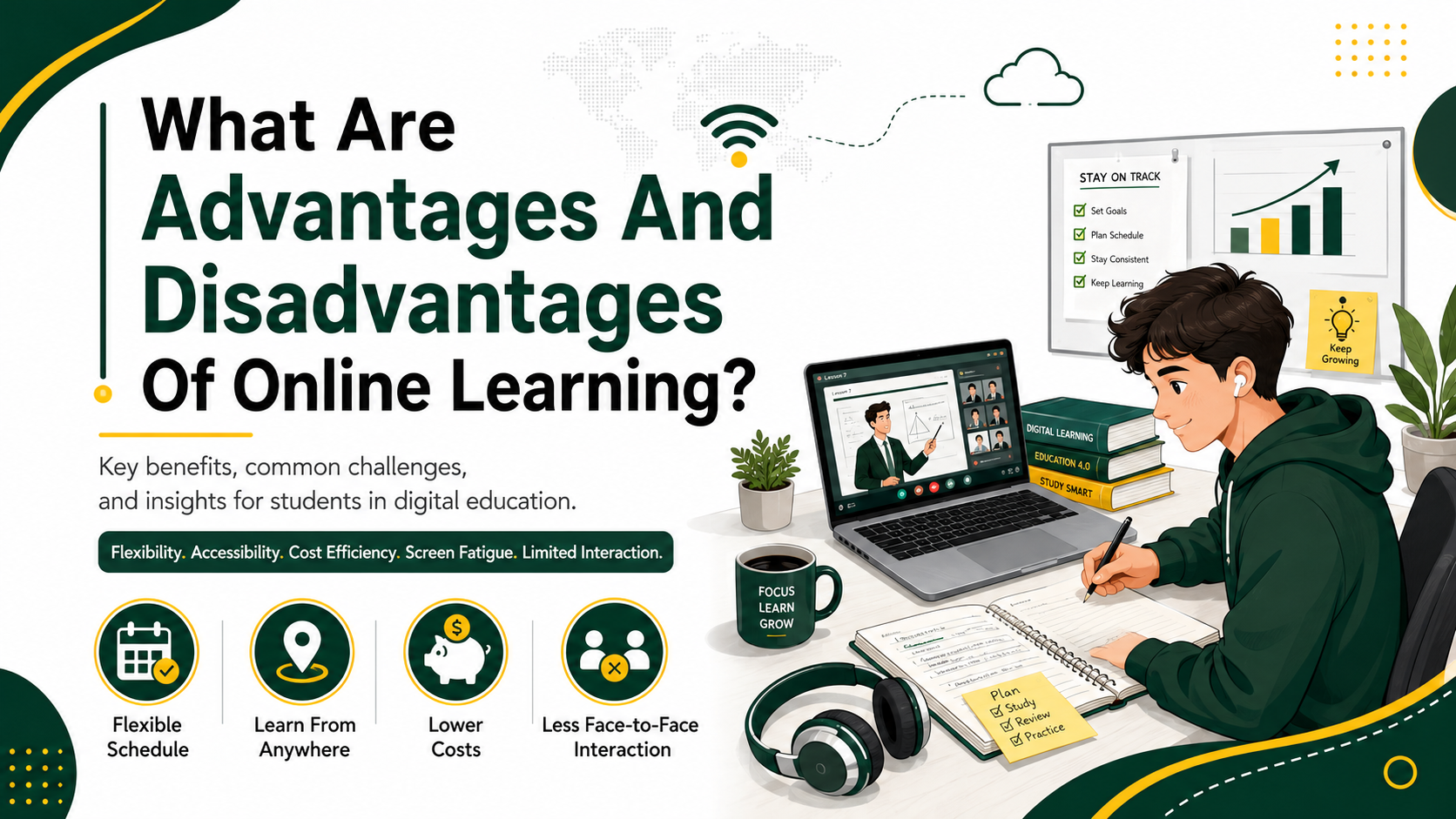
Online learning offers opportunities for everyone, whether a college student, a working professional, or someone who simply wants to learn a new skill. You can attend these classes from your living room, learn from instructors in another country, and even move through lessons at your own pace. This may sound perfect to you. Like other methods, online learning also comes with weaknesses and strengths. In this blog, you will explore the advantages and disadvantages of online learning to choose the right fit for your goals and learning style.
The way of gaining knowledge and developing skills has changed through online learning. A few years ago, students saw online classes as a backup option, but now they are a normal part of education for many people around the world.
What Is Online Learning?
The education that is delivered through the internet is online learning. Instead of attending classes in a traditional classroom, students can access lectures, assignments, discussions, and learning materials through digital platforms. Some courses allow students and instructors to interact in real time, while others are recorded, enabling learners to study at their own pace whenever they choose. You can also think of it like a classroom in your pocket, which is convenient and flexible. This method of learning also depends on how well you manage this freedom.
Advantages of Online Learning
As everything has some of its cons and pros, so there are also advantages and disadvantages of online learning. Let’s have a look at the top advantages of online learning.
1. Flexibility and Convenience
Flexibility is one of the biggest advantages of online learning. Students can choose the time and place option for studying. This is the reason that it is valuable for people who have family, jobs, responsibilities, and busy schedules.
Instead of going to a campus, you can log in from home, a coffee shop, or even while traveling, so this can save you time. Avoiding daily travel means having more time for studying, work, or personal activities for many learners.
2. Access to A Wide Range of Courses
Traditional schools are limited by location and available faculty. Online learning removes many of those barriers to education. A student in a small town can enroll in a course that is taught by an expert from another country.
Students can learn specialised programs that may not be available, such as coding, digital marketing, graphic design, and business. The advantage of a wide range of courses is impressive. This access enables the students to explore other interests and career paths that might be unavailable.
3. Learn at Your Own Pace
Many online courses allow students to review and learn lessons multiple times. If you did not understand a concept the first time, then you can simply replay the lecture.
This approach helps learners absorb information more effectively. In a traditional classroom, the instructor usually moves forward according to a fixed schedule. Online learning often gives students greater control over the speed of their education.
4. Cost Saving
Online education is now more affordable than traditional learning. Students can save money on transportation, housing, parking, printed materials, and other campus-related expenses. There are also some online courses available, which are even free.
Degree programs still require tuition, while the overall cost is lower than attending classes in person. Some students often get help from online services and search for do my assignment for me at a low cost to manage their studies with work and other commitments.
5. Improved Technical Skills
Students can naturally develop digital skills by participating in online learning. Students can learn the use of video conferencing tools, collaboration software, learning management platforms, and cloud storage systems.
These abilities are increasingly valuable in modern workplaces. It’s almost like getting two educations at once, one in the subject you’re studying and another in digital communication.
6. Better Work-Life-Education Balance
Many adults return to school while maintaining full-time jobs and this becomes possible through online learning.
Instead of choosing between earning an income and continuing education, learners can often do both. That is why this flexibility allows people to improve their qualifications without putting their careers on hold.
Disadvantages of Online Learning
You have now understood the advantages of online learning, which have made the student’s life much easier. Let’s have a look at the disadvantages of online learning.
1. Limited Face-To-Face Interaction
The lack of in-person communication is the most common complaint about learning online. Classroom discussions are an important part when students share the same physical space. Online environments can reduce discussions and make conversations feel less personal.
Some students miss the social experience of traditional education, which is completely understandable. Human interaction plays an important role in learning, motivation, and building relationships.
2. Requires Strong Self-Discipline
Online learning offers freedom, but freedom also comes with responsibility. Students must manage their own schedules and stay motivated without a teacher physically present.
This can be challenging. When all the lessons are available online, then procrastination can become a bigger risk. Many students struggle to stay focused, especially when distractions are only a few clicks away.
3. Technology Issues Can Disrupt Learning
One of the crucial requirements of the online courses is a stable internet connection. Delays and missing live classes can happen due to technical problems.
Various issues like internet outages, audio issues, or device failures can disrupt lessons and create frustrations. Students with a lack of reliable technology may face these types of challenges, which can affect their learning experience.
4. Few Hands-On Learning Opportunities
Many subjects don’t just rely on theory, but also require practical experience. For example, medical training, engineering, and some vocational programs mostly depend on hands-on practice.
Technology has improved virtual simulations, but they cannot replace real-world experience. There is a difference in watching someone ride a bicycle and actually riding one by yourself.
5. Potential Feeling of Isolation
Studying alone for long periods can sometimes feel isolating. Traditional classrooms naturally provide opportunities for friendship, teamwork, and social support. Online learners may have fewer chances to build those connections.
Some people thrive independently, while others cannot. Learning preferences vary from person to person, which is why online education is not equally effective for everyone. In some cases, students also look for online exam helpers in Australia when facing academic pressure and remote assessment challenges.
6. Screen Fatigue
Many online courses need hours of screen time. After attending virtual lectures, reading digital materials, completing assignments, and participating in online discussions, students may experience eye strain or mental fatigue.
It’s a real concern. Taking regular breaks and maintaining healthy study habits can help reduce these effects, but the challenge remains for many learners.
Frequently Asked Questions
1. Is online learning as effective as traditional classroom learning?
Yes, online learning will only work if the courses are well-designed and students engage well. Online classes can lead to success depending more on the student’s study habits and motivation than the learning format.
2. Which skills are important for success in online learning?
The most important skills for online learning are time management, communication skills, self-discipline, and basic computer knowledge.
3. Who benefits the most from online learning?
Online learning programs can greatly benefit most people, including working professionals, remote learners, busy parents, and individuals looking for flexible education options.
Conclusion
Online learning has opened a lot of doors for students, making education accessible and flexible. It is a part of education that involves the internet to learn from the comfort of your home. You have already read about the advantages and disadvantages of online learning in this blog. This has various benefits, including flexibility and convenience, accessibility to a wide range of courses, and cost savings. It also enables you to learn at your own pace, improve your digital skills, and offers a better work-life education balance.
At the same time, it has some limitations of face-to-face interactions, needs strong self-discipline, and leads to screen fatigue. Technological issues can also disrupt learning, lack of hands-on practice, and a potential feeling of isolation. One of the best ways to achieve success is to evaluate your learning style and educational goals.