Moments in which something happens and, strangely, everything stops do not happen all the time, but when they do, it can send chills down your spine. The clock would still keep ticking. People would talk, and life would continue to demand responses.
But inside you, the time collapses into a single, steady heartbeat. As if the heart is no longer alive. If you ever felt anything of that sort, you can call it being traumatised. If you are interested in knowing more, it is for you! Together we will explore:
- How does the mind freeze?
- Why do certain moments never feel ‘over’?
- Why healing isn’t linear?
- Why can emotional responses feel delayed, muted, or overwhelming long after the event has passed? And a lot more.
Trauma Keeps You Stuck in the Same Moment
Some worrying thoughts were keeping Sarah up. If her thoughts were loud enough, you could clearly figure out that they screamed the following sentences repeatedly.
‘I don’t know what is happening to me. I don’t know what is going on.
And the worst part is, I don’t think anybody knows about it either.’

Poor Sarah. It has been months since the accident she saw, but she is still living that memory at least a dozen times during the day. Sure, it is no fun being trapped in the same moment.
We wish she had a choice and could snap out of it real quick. It is almost like this event has hijacked her sense of time and refuses to let her move on.
Basically, Here’s What is Happening
She is experiencing the aftershocks of pain and stress that keep on lingering and locking her inside yourself. It could have been anyone in her place. Even you, the person reading this blog. Also, she isn’t the first one to witness the trauma. There have been millions before her and will be after her, going through similar experiences.
Also, it is a common complaint that victims find themselves hanging in between, immediately after a tough event in life. This, however, is not a clinical lecture or a self-help checklist. We will only be sharing with you what it feels like to be stuck inside a memory you did NOT choose.
Trauma and the Broken Language of Time
Believe it or not, suffering doesn’t announce itself loudly. It also won’t knock on your door. It just arrives silently, sneaking into your mind without you even realising. Then, as soon as it makes itself comfortable in there, it starts altering your perceptions.
One of its first casualties is time.
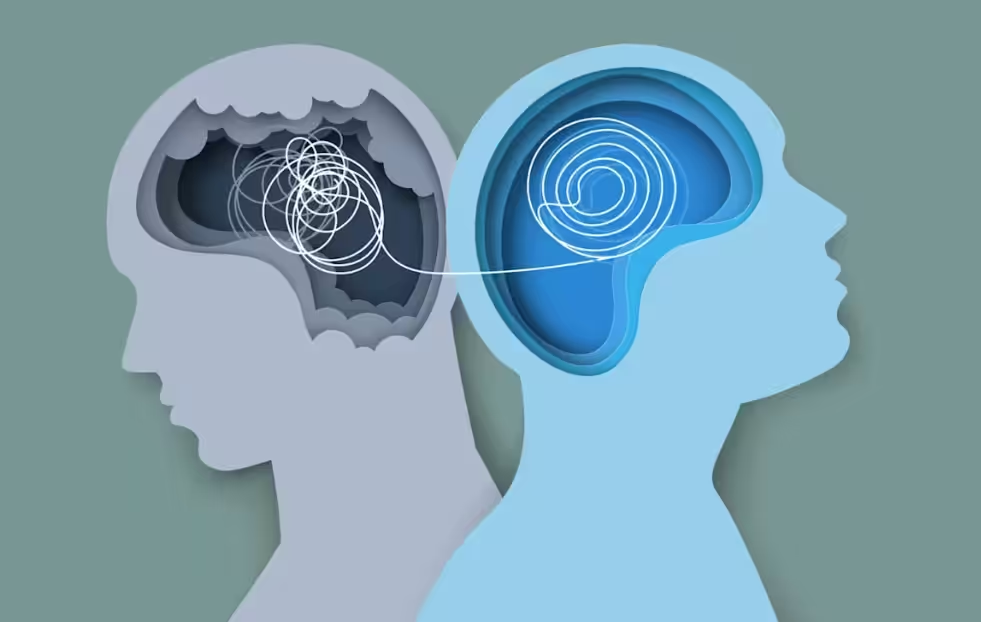
You will notice how past, present, and future no longer line up neatly. Instead, the mind begins to speak in fragments. In simple words, a traumatic memory doesn’t live where ordinary memories live. It doesn’t say, ‘This happened, and now it’s over.’
It says, ‘This is still happening.’ That is surely the reason why a single sound, a smell, or a sentence can suddenly pull someone back into an emotional state they thought they had left behind. Weeks of moving-on effort can be shattered in seconds because of this.
If you put it the other way, it might be true that suffering creates its own internal language.
The one where time is circular, compressed, or frozen altogether.
The ‘Freeze’ Responses
We often talk about fight or flight, but trauma frequently triggers something far worse: freeze. During this state, your body goes still. Thoughts don’t follow anymore, and emotions retreat. If you are mistaking it for weakness. DON’T. It is pure protection. Your body is trying to save you.

All in all, when the mind perceives something as overwhelming or inescapable, freezing becomes a way to escape. According to studies, people often describe this condition as numbness, dissociation, or feeling like a spectator in their own life. It might be a little scary, but this frozen state can last long after the danger is gone. You can also find books about emotional trauma everywhere.
Memories That Refuse to Stay in the Past
Even the scientists agree that some tough moments are stubborn enough to keep entering the present. They will never behave like a story with a beginning, middle, and end. Instead, they behave like a loop, where you keep on living it again and again.
And because it lacks emotional distance, the mind reacts as though the event is happening now. This is why people say trauma lives in the body. It shows up as tension, fatigue, hypervigilance, or sudden emotional flooding. It is as if the nervous system never received the message that the threat ended. Though to some people, it might look like an exaggeration.
Reminders For Everyone
What looks like an overreaction is often a delayed reaction.
What looks like avoidance is often self-preservation.
10 Common Reasons Behind Someone’s Trauma
- Accidents can leave people scared for a long time.
- Violence or assault hurts both body and mind.
- Natural disasters destroy homes and safety.
- War or conflict makes people live in fear.
- Neglect makes someone feel unwanted and alone.
- Bullying or harassment breaks confidence and trust.
- Sudden loss leaves deep sadness and shock.
- Chronic stress wears down health and hope.
- Witnessing trauma makes painful images stay inside.
- Medical treatments or diagnoses can feel frightening.
Healing Is Not Directly Proportional to the Time After an Event
It is a major misconception that with passing time, the stress or aftershocks will also go away. The truth is otherwise. Sometimes there is slow progress, and sometimes there isn’t any at all.
It might just feel like you are growing older, the environment is changing, and you are building a new life, yet some days you find yourself totally lost.
Unable to move.
Unable to respond.
Also, no idea how long you’ve been standing there.
It is almost like seconds feel like minutes and minutes feel immeasurable.
This is because trauma is not resolved by distance alone. Without intervention, the mind continues to hover in that frozen space, not from fear, but from what comes after fear.
- The numbness
- The detachment.
- The absence of feeling.
The Quiet Power of Genuine Human Connection
What finally allows time to move again is not explanation or logic, but presence, especially for someone who brings your insides some peace. In a nutshell, healing begins when someone notices the stillness and does not rush to fix it.
Or when a person is met with patience instead of pressure, the nervous system slowly learns that it no longer has to stay frozen. It is a bit unbelievable, but the movement returns. Maybe not all at once, but gently through breath, through words, through being seen.
Experts and authors like Katelyn Emilia Novak also agree that a genuine human connection can offer what trauma once lacked. It can give you a sense of safety without conditions. After all, who doesn’t want to be listened to, believed, or allowed to exist without urgency? Certainly, all of us.
The Final Words
Trauma indeed freezes time, but this is not because the mind is broken. It is rather because it is trying to protect what matters most. YOU and YOUR SANITY. Though the real healing begins when we stop rushing that process and start understanding it.
Time also returns gradually if someone stays patient with you and continues to make steady efforts. So, if by any chance you fall for such an event in life or your dear friend, make sure that the victim has someone they can count on. This special person should be around most hours of the day for gradual and firm recovery.