In an age where threats to security are evolving faster than ever, organizations and homeowners alike are realizing that traditional locks and keys are no longer enough. From corporate campuses to residential communities and healthcare facilities, the demand for intelligent, reliable, and scalable access control systems is skyrocketing.
Access control is no longer just about keeping doors locked — it’s about protecting people, safeguarding assets, ensuring accountability, and empowering organizations with real-time insights. This guide dives deep into the world of access control systems — what they are, how they work, the latest trends shaping their future, and how innovative solutions like the Nialabs Access Control System are transforming security.
What Is an Access Control System?
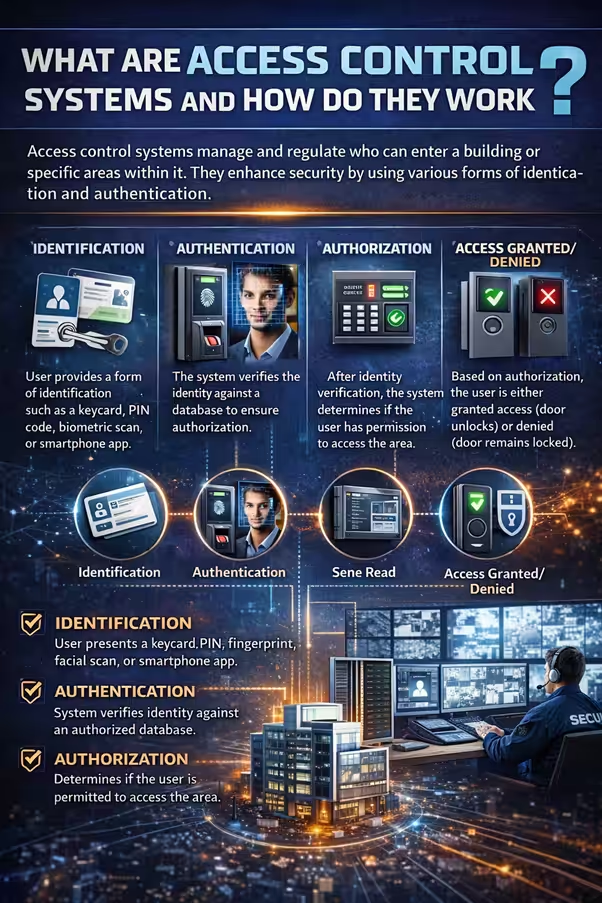
At its core, an access control system (ACS) is a security solution that regulates who can enter specific physical or digital spaces, and under what conditions. Whether it’s allowing an employee into a data center or a visitor into a lobby, an access control system determines who is allowed, when, and where.
Unlike traditional locks that grant access to anyone with a key, modern access control systems use sophisticated methods such as biometrics, smart cards, PINs, mobile credentials, and AI verification, making unauthorized entry exponentially more difficult.
Key Components of an Access Control System
To understand how these systems work, let’s break down their core building blocks:
1. Access Credentials
These are the means by which a user identifies themselves:
- Smart Cards
- PIN Codes
- Biometrics (fingerprint, facial or iris scan)
- Mobile Credentials (Bluetooth, NFC)
2. Access Control Readers
These devices read credentials presented by a person:
- Card readers
- Biometric scanners
- Mobile/NFC readers
3. Control Panel / Controller
The “brain” of the system that processes the authentication request and decides whether to grant or deny access.
4. Access Control Software
A centralized platform to:
- Manage users
- Define access rules
- Generate reports
- Monitor events in real time
5. Locking Mechanisms
Hardware that physically secures the entry point:
- Magnetic locks
- Electric strikes
- Smart locks
How Do Access Control Systems Work?
Here’s what happens when someone tries to enter a secured area:
- Authentication Attempt:
A user presents their credential (card, fingerprint, mobile app). - Data Capture:
The reader scans the credential and sends the data to the controller. - Verification:
The controller checks the credential against stored authorized data. - Access Decision:
The system decides whether to grant or deny access. - Response:
If authorized, the door unlocks. If not, the system logs the event and may trigger an alert. - Audit Logs:
All activity is recorded for real-time monitoring and historic reporting.
This seamless process happens within milliseconds — making authorized entry smooth and secure.
Types of Access Control Systems
Different applications require different approaches. Here’s how the major systems compare:
Discretionary Access Control (DAC)
- Users control their own access permissions.
- Less secure, limited for personal environments.
Mandatory Access Control (MAC)
- Central authority controls access.
- Highly secure, ideal for governments and defense.
Role-Based Access Control (RBAC)
- Access based on job role.
- Scalable and efficient for enterprises.
Attribute-Based Access Control (ABAC)
- Decisions use real-time context (location, time, risk score).
- Smart and adaptive, perfect for high-security and dynamic environments.
Access Control Systems vs Traditional Lock-and-Key
| Feature | Access Control System | Lock & Key |
| Security Level | High | Low |
| Key Duplication Risk | None | High |
| Remote Management | Yes | No |
| Audit Trails | Detailed | None |
| Scalability | Excellent | Poor |
| Cost Efficiency Over Time | Very High | Moderate |
Digital access control systems crush traditional locks in security, insight, and management. A lost key might compromise an entire facility, but a lost digital credential can be disabled instantly — minimizing risk and downtime.
Benefits of Using Access Control Systems
Modern access control delivers powerful advantages:
- Unmatched Security: Prevents unauthorized entry.
- Complete Visibility: Audit trails show who entered where and when.
- No Key Mismanagement: Eliminates lost keys and re-keying costs.
- Centralized Control: Manage multiple doors, sites, or buildings from one platform.
- Remote Access: Administrators can update permissions from anywhere.
- Integration-Ready: Works seamlessly with CCTV, alarms, and HR systems.
- Compliance Assistance: Helps meet industry security standards.
Applications of Access Control Systems Across Industries
Access control isn’t one-size-fits-all — it’s powerful across sectors:
Corporate Offices
Secures sensitive departments and enables employee access logging.
Educational Institutions
Controls student access and integrates attendance systems.
Healthcare Facilities
Protects patient data areas and restricted zones.
Industrial Units
Prevents entry to hazardous zones and manages shift-based access.
Residential & Commercial Buildings
Offers visitor control and smart entry to residents.
Choosing the Right System: What Matters Most?
When evaluating access control technology, consider:
- Size of facility
- Number of users
- Level of required security
- Type of authentication (biometric, mobile, card)
- Cloud vs on-premise solutions
- Integration with existing tech
- Budget and scalability
Choosing wisely now will save you time, money, and risk later.
Future Trends in Access Control Technology
Here’s a snapshot of emerging tech that’s reshaping the industry:
| Trend | Description | Benefits | Use Cases |
| AI-Powered Facial Recognition | Advanced face analysis to verify identity | Speedy, secure, hands-free access | Airports, corporate buildings |
| Mobile-Based Access | Smartphones as credentials via Bluetooth/NFC | No cards, convenient | Offices, apartments |
| Cloud-Managed Systems | Central cloud dashboard for access control | Remote control, scalability | Chain businesses |
| Touchless Authentication | Contactless capture (biometrics/mobile) | Improve hygiene, great UX | Healthcare, public spaces |
| IoT Integration | Connection with smart sensors/devices | Smart automation | Smart buildings |
| Behavioral Biometrics | Patterns like gait or typing for authentication | Low-effort, high security | High-risk environments |
| Data-Driven Analytics | Uses logs and trends for risk insights | Better threat prediction | Security operations centers |
| Adaptive Access (ABAC) | Context-based decisions | Dynamic security | Hybrid workplaces |
| Blockchain Logging | Immutable event logs | Tamper-proof records | Regulated industries |
| Multimodal Biometrics | Combines multiple biometric methods | Stronger security | Financial, research |
These trends signal a future where access is intelligent, adaptive, and seamlessly integrated with broader security ecosystems.
Spotlight: Nialabs Access Control System
When it comes to cutting-edge access security, the Nialabs Access Control System stands out as a robust, future-ready solution designed for modern enterprises and smart facilities.
Key Features:
- Advanced Authentication: Facial recognition, biometric scanning, and mobile credential support.
- Centralized Cloud Dashboard: Manage all access points from anywhere.
- Real-Time Alerts: Instant notifications on unauthorized attempts.
- Seamless Integration: Works with CCTV, alarms, and HR systems.
- Scalable Architecture: Ideal for small offices to multisite enterprises.
- Data Analytics: Powerful insights and customizable reporting.
With its rock-solid security, intuitive UI, and scalable design, the Nialabs system empowers organizations to control access with confidence and respond to security events in real time.
Frequently Asked Questions (FAQs)
Q: What is the main purpose of an access control system?
A: To restrict unauthorized entry and manage secure access.
Q: Are access control systems better than traditional locks?
A: Absolutely — with better security, remote control, and accountability.
Q: Which system works best for offices?
A: Role-Based and biometric access systems are ideal.
Q: Can access control systems track attendance?
A: Yes, many systems integrate with attendance and HR software.
Q: Are biometric access systems safe in India?
A: Yes, when implemented with proper privacy safeguards.
Q: Do access control systems work during power outages?
A: Most have battery backups and fail-safe designs.
Conclusion: Secure the Future Today
Access control systems are no longer optional — they are essential security infrastructure. By combining cutting-edge technologies, robust policies, and intelligent systems like Nialabs, organizations can achieve unparalleled security, efficiency, and peace of mind.
Adopt smart access control now and transform how you protect people, data, and assets — because security should evolve at the pace of risk, not behind it.