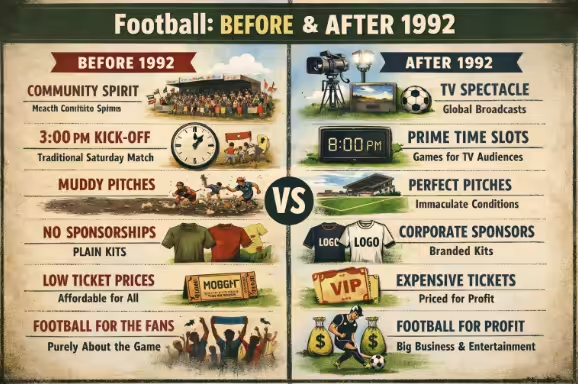
The last decade of the 1900s marked a permanent shift in football from a local sport to a global commercial product. According to the sources, this transformation was inspired by the creation of the English Premier League in 1992. This was not just any league. It was a planned one, with goals such as prioritizing television rights, high-end presentation, and choosing worldwide branding over traditional sporting fairness.
By moving the game behind a paywall and focusing on entertainment value, the league changed the DNA of the sport forever. However, more than two-thirds of the game fans have been sleepwalking until now. This blog intends to shake the readers out of autopilot and urge them to see three important realities. It talks about:
- The breakaway moment in 1992 was the start of football as big business.
- The economic-win chase, which has created an eternal gap between the clubs.
- Selling the show made replays and hype as important as the goals themselves.
The Late 1990s Changed the Way We Consume Football
Speaking of the transformation of football from a favorite pastime into a product-first commercial entity was a gradual process. However, it is largely associated with the formation of the English Premier League. Thanks to the branding and the giant revenue generation.
But did you know 1992 wasn’t the starting point of football’s commercialization?
The first step towards the game shifting into a global product was taken at least fifteen years before the 19th century even began. Yes, in 1885, the official moment when professional football was born. Let’s go through the journey with the help of a timeline.
Timeline of the Game’s Product-First Era
1885–1888 | The Birth of Professional Football
- 1885: The FA legalises professionalism, allowing players to be paid.
- 1888: The Football League is formed to ensure regular fixtures and predictable income.
Significance: The game went from amateur pastime to organised labour and revenue.
1958–1970 | The First Global Icons
- Late 1950s–60s: Pelé becomes the first truly global football superstar.
- 1970: The black-and-white 32-panel ball is introduced for better TV visibility.
Significance: Players and even equipment began to be shaped for media and mass appeal.
1981 | Commercial Branding Enters the Shirt
- 1981: Racing de Santander wore Teka as Spain’s first shirt sponsor.
Significance: Kits became advertising space, and clubs became moving billboards.
1992 | The Premier League Moment
- 1992: English top clubs break away to form the Premier League.
- Deal with Sky Sports (TV channel) reshaped football economics.
- Kick-off times, branding, and presentation are redesigned for broadcasters.
Significance: Football is formally packaged and sold as a television product now.
2000–2007 | The Era of the Superstar Brand
- Early 2000s: Real Madrid’s Galácticos model treats players as global assets.
- 2007: David Beckham moves to LA Galaxy, leaving behind sport for celebrity status.
Significance: Photos, merchandise, and global fame became as important as the game.
2010s | Capital, States, and Scale
- Heavy investment from billionaires, private equity, and state-backed owners.
- Clubs like Chelsea and Manchester City redefined competitive and financial power.
Significance: The game is now a high-stakes industry, with most of the wealth in a few hands.
2018–Present | Protecting the Product
- 2018: VAR is introduced to improve accuracy and broadcast reliability.
- Digital content, global fanbases, and nonstop monetisation dominate your favorite sport.
Significance: Today, it is all about guarding the profits and maximizing global viewership.
Why are the Late 1990s Considered a Plot-Twist
For those who aren’t aware, the late 1990s were a few significant years where fans saw the game’s money suddenly go from millions to billions. Here is a chain depiction of the events.
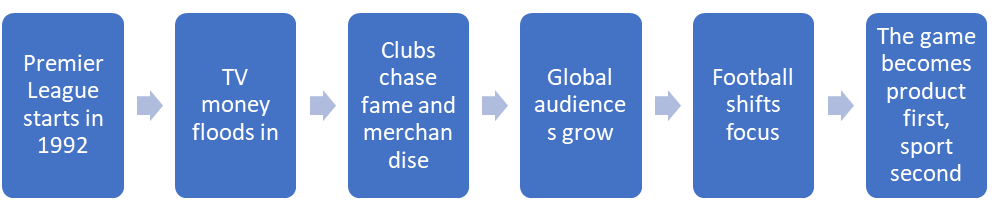
Their goal was to keep more of the television money for themselves, and by forming the Premier League, they could negotiate their own deals with broadcasters.
Then in 1997, a massive TV deal poured record-breaking cash into the league. This turned teams into public companies that are now trading on the stock market. Naturally, this meant clubs were supposed to answer to investors, too, and not just fans.
A Quick Comparison
If you have read books about football before 1992, it looked and felt like a community event. Stadiums were often crumbling, and the way games were shown on TV was simple and functional. However, a group of club owners and television executives realized that football was sitting on a gold mine.
They realized that if they could package the sport correctly, they could sell it to the world as a premium entertainment product. This was the moment football stopped being a service for the local community and started being a product for a global audience.
The focus shifted from – How do we play the best game?
To – How do we make this game look best on a screen?
The Key Changes That Hit the Fans
- The game was moved to a subscription-based satellite TV service. As a result, fans now had to pay extra to watch their team.
- The matches were moved to different days of the week just to satisfy TV schedules, making it harder for local fans to attend.
- For the first time in forever, English football was aggressively marketed to fans in Asia, America, and Africa.
Presentation Over Sporting Fairness
Once football became a product, the presentation became more important than the fairness of the competition. Broadcasters introduced pre-game shows, flashy graphics, and celebrity analysts. They wanted the game to feel like a Hollywood movie.
However, this created a massive gap in the sport, sketching a fine line between the rich and other clubs. It was evident that the teams at the top kept becoming incredibly wealthy, while the teams in the lower leagues were left behind.
Unlike the old days, when a small team had a fair chance to climb to the top.
Is the Product Better Than the Sport?
It is important to admit that, as a product, modern football is incredible. The stadiums are safer, the players are faster, and you can watch every second of the action in high definition from your phone. But for many, the sport has openly suffered.
When a game is treated like a product, the people in charge are afraid of anything that might hurt the brand. This is why we see so much control over player interviews and why ticket prices have pushed out the original working-class fans.
The Final Words
The creation of the Premier League was the moment the fan was replaced by the consumer. While the game has never been more popular or more beautiful to look at, the late 1990s were indeed a turning point. This was where the profit calculations and balance sheet officially became more important than the trophy cabinet.
All in all, even when the traditional soul of the game and the modern commercial product are poles apart, football has fully accepted its identity as a global commodity. So, now fans like Kristian Russell can enjoy the high-quality show, but they must also recognize that the sport they see today was designed in a boardroom, not on a playground.