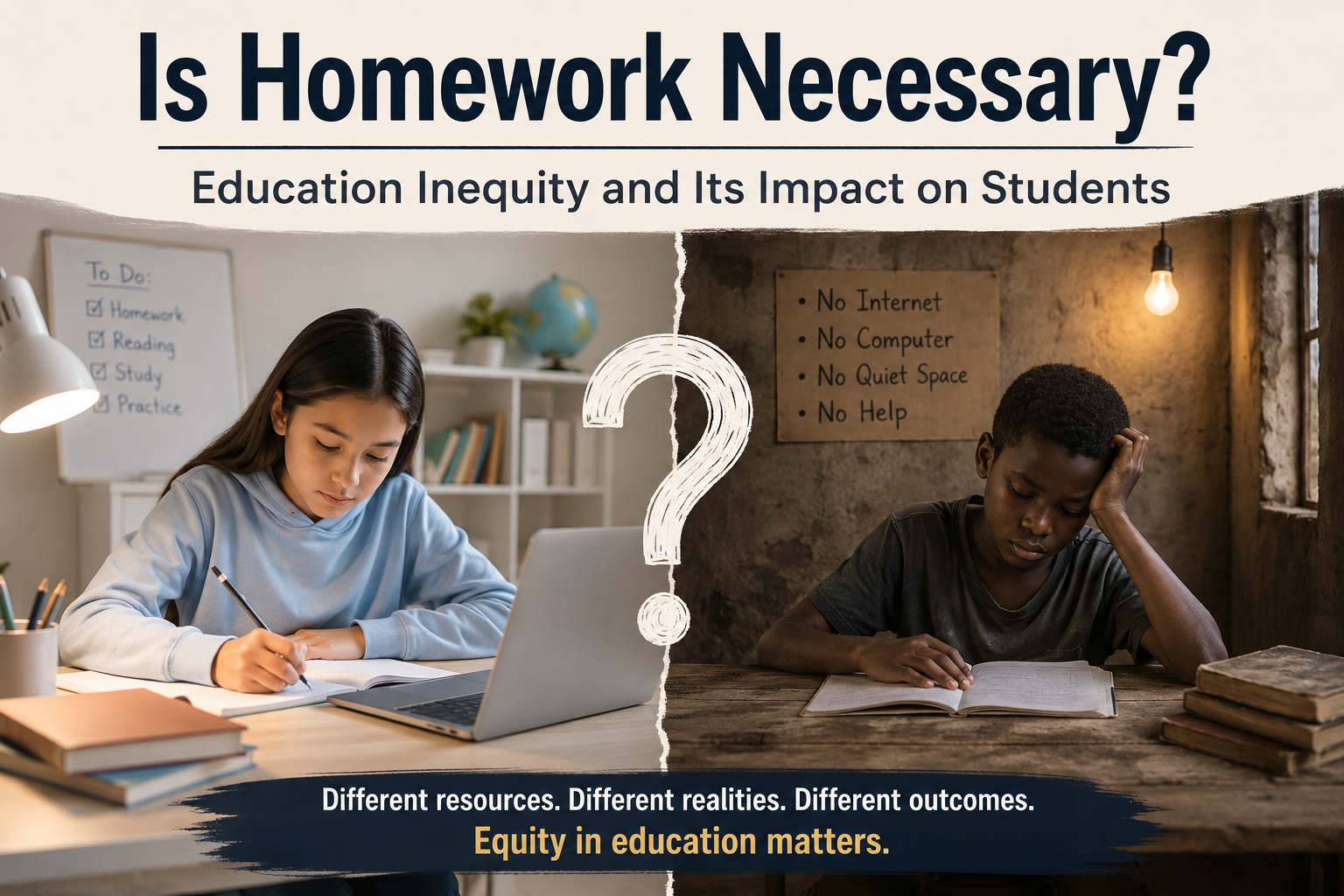
Is homework necessary? It is a decade-old debate that is yet to be settled. While homework can reinforce learning and develop independent study skills, it relies heavily on home conditions that most schools never consider, such as a quiet room, access to the internet, or a parent who has time for homework help.
Homework is usually a reflection of family circumstances rather than students’ learning. Suppose you gave the same homework to three dozen students. One’s home has a quiet study room, one’s parents are university graduates, and one’s laptop is a flawless one.
On the other hand, one goes back to a noisy apartment where the parents work night shifts, and the phone is out of data more often than not. Both have the same worksheet, but one is tested on the worksheet, and the other is tested on circumstances.
Why Does Homework Affect Some Students More Than Others?
Homework was conceived on the premise that no longer exists: that all children go home to a supportive, resourced home environment where they can focus on their homework. Twenty years ago, this was the norm, with school being the only place they learned, but now, home is the extension of school, and that extension can be unequal for some.
The gap shows up most clearly in three distinct areas that schools rarely measure, but that quietly decide how much of an assignment a student can actually complete: access to technology, parents’ availability, and the space available for quiet, focused learning. These factors lead them to online homework writing services.
Access to Technology and the Internet
Homework is becoming reliant on a working device and reliable internet, whether for research, online quizzes, or video lectures. Those who don’t have a reliable device at home will have to rush to complete tasks at the library before closing or share a family phone.
Analysis reveals that Black, Hispanic, and teens with low family income are significantly more likely to report not having dependable technology for completing homework. The same assignments can be harder for a whole demographic without anyone ever realizing it. This research shows us that it has gone beyond the genre question of is homework necessary.
Parental Availability and Educational Background
A student who is having trouble with a concept requires an adult who has the time and educational background to explain it to them. Families that work multiple jobs, have irregular work schedules, or don’t speak English can be just as loving and supportive, but may not naturally fall into that category.
The same is true for physical space: a student who has their own room can work for hours at a time without interruption, while a student who shares a room with siblings will need to work in bits and pieces of quiet. Finally, the traditional homework environment values parental availability and space as well as the students’ effort.
Is Homework A Help Or A Hindrance To Learning?
Research on the academic benefits of homework varies by grade level. Research follows high school students and reveals a significant correlation between homework and higher test scores: older students have the cognitive capacity to use homework as a supplement to the in-class learning experience.
The situation is completely different with the younger children. Research over the years, much of it from Duke University’s Harris Cooper, indicates that homework has little or no positive effect on elementary school children.
Once students are past the grade level, quality is most important; a repetitive worksheet is hardly a reward for students who grasped the lesson. Faced with these challenges, many students rely on assignment help Australia to get the targeted, structural explanations they cannot find anywhere else.
What Can Schools Do to Make Homework More Equitable?
Not all homework is created equal, and most teachers contend that removing it altogether would deprive students of a valuable learning tool. Another more realistic approach would be to rethink homework practices in assigning, supporting, and marking it to prevent it from subtly punishing students for their living situations back home.
Building Access into the School Day
Some schools have adopted in-class structured study time, after-school homework clubs, or a device and hotspot lending program, which reduces the “digital divide” before students leave school. These programs have been successful because they act at the root of the inequity.
- Homework clubs with staff and/or peer tutors on campus after school.
- Lending programs of devices and Wi-Fi hotspots for students who do not have home Internet access.
- Class time is intentionally set aside during the class period for the student to get started with assignments before they leave the classroom.
Rethinking What Gets Assigned and Graded
In some districts, students’ homework is now being marked for effort and completion, not correctness, because a student with no homework help is much more likely to try a “wrong answer” than a “right answer.” Others have cut down on the quantity of assignments and made them more in-depth.
- Grading homework for genuine effort and completion and not for accuracy.
- Cutting down on homework quantity to increase homework quality.
- Providing students with flexibility with deadlines if they have work or family obligations.
The real debate isn’t just ‘is homework necessary’; instead, it is about meeting students where they are and designing an educational system from their perspective.
FAQs
What happens when teachers don’t grade homework for correctness?
They change the focus of their grading to brief, in-class assessments such as a quiz or “exit ticket” question. This tests real learning without penalising students who did not get assistance at home.
Is it detrimental to college preparation for older students to have less homework?
No, not quantity, quality. A change from time-consuming, repetitive tasks to shorter, deeper task assignments still fosters effective study habits, while avoiding burnout and exacerbating inequities.
If parents don’t know the material, how can they assist?
They don’t need to teach the curriculum to be supportive. Just the small suggestions of helping set up a daily study schedule, helping their child protect a quiet time for study, and asking their child to explain the lesson go a long way.
Conclusion
Homework is a tool, and its effect is determined by how it is used. It helps students who have a quiet room, stable internet service, and an available parent, but for a student who doesn’t have those resources, it is a reminder that they are living in a structure that is not the same.
It is this type of resource gap that many students who have been struggling seek assistance to fill, as a busy household cannot provide the structural explanations they need. Instead of ditching homework altogether, a thoughtful approach is to reimagine homework to address these inequities.